

Quick Answer
- Manufacturer rebates are incentives paid by the brand that makes a product.
- Distributor rebates are credits or payments tied to your purchase volume with the wholesaler that delivers it.
- Who actually gets paid depends on your contract: a rebate paid to a distributor only reaches the restaurant if the agreement says it must be passed through.
Introduction
Restaurant profit margins are famously thin. Industry estimates commonly put pre-tax profit at just 3% to 5%. So when a rebate is supposed to shave a few points off your food costs, you’d expect it to land in your account. Often, it doesn’t.
I’ve seen operators sign a supplier agreement, buy thousands of dollars of product every week, and never see a dime of the rebates tied to those purchases. Where did the money go? Usually it went to someone else in the supply chain.
Here’s the thing. The terms “manufacturer rebates” and “distributor rebates” get thrown around as if they mean the same thing, but they don’t. One is paid by the brand that makes the product. The other is tied to the wholesaler that delivers it. Understanding manufacturer rebates vs. distributor rebates is the first step to keeping more of your margin.
In this guide, we’ll break down how each rebate works, who gets paid, and how to make sure your restaurant isn’t leaving money on the table. If you want a broader primer first, start with our guide to food rebates.
What Are Manufacturer Rebates in Foodservice?
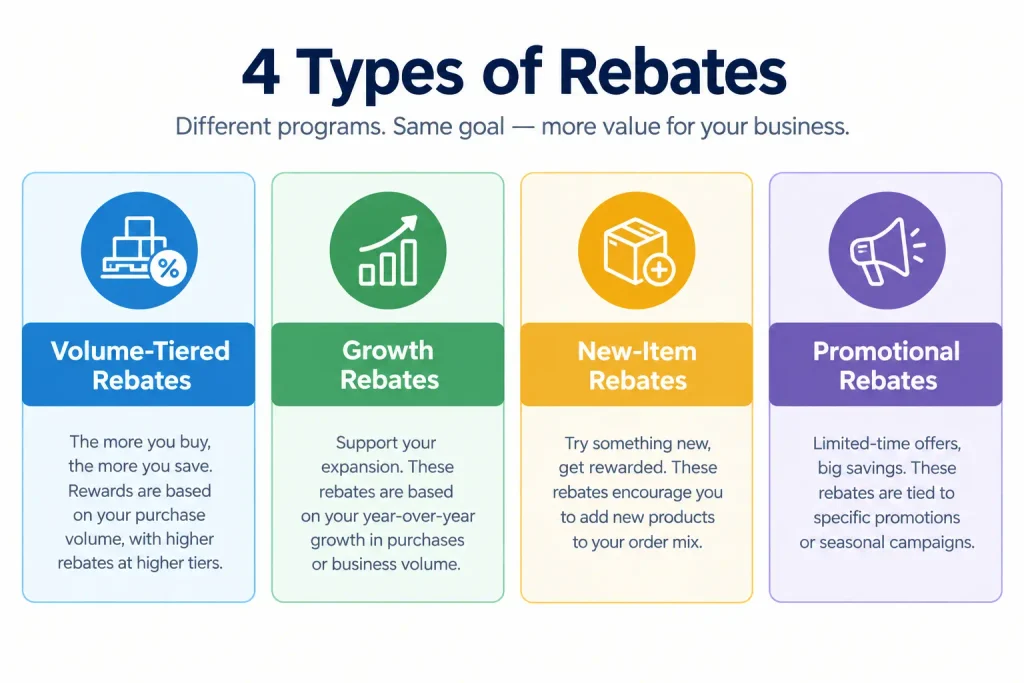
A manufacturer rebate is an incentive paid by the brand or producer to drive volume, trial, or loyalty. Think of a cheese producer that wants you to switch brands, or a beverage company that rewards you for hitting a purchase target.
These rebates come in several common forms:
- Volume-tiered rebates reward you as your purchases climb past set thresholds.
- Growth rebates pay out when you buy more than you did in the previous period.
- New-item rebates encourage you to try a product the manufacturer is launching.
- Promotional rebates support limited-time campaigns, such as seasonal menu pushes.
Manufacturer rebates for restaurants are typically structured per case, per pound, or as a percentage of spend. The payout might arrive as a check, a credit, or a deduction applied through your distributor.
Eligibility is where it gets tricky. Some programs are open to operators directly. Others are available only to GPO members or are paid to the distributor, who is then expected to pass the value along. Manufacturers often prefer rebates over lowering list price because rebates are targeted. They pay out only when you hit a specific behavior, and they don’t reset the price every other customer sees.
What Are Distributor Rebates on Food Purchases?
Distributor rebates are payments or credits tied to your purchasing volume with a broadline or specialty distributor. The distributor is the middleman, and that makes this category more layered than it looks.
Common forms include volume rebates, prompt-pay discounts, and rewards for hitting purchasing thresholds across your account.
But there’s a critical distinction. There are rebates the distributor pays you, and there are rebates the distributor receives from vendors based on the volume it moves. The second kind can be substantial, and it doesn’t always reach the operator.
How this plays out depends on your pricing model. Under cost-plus pricing, the distributor charges you its cost plus an agreed markup. Whether that “cost” reflects vendor rebates and allowances is a question of contract language. Under fixed markup or deviated pricing, rebate value may be baked into the price you see, or it may be invisible altogether.
Then there are vendor allowances and manufacturer bill-backs. These are funds a manufacturer provides to a distributor to cover promotions or price reductions. Whether they benefit you depends on how the distributor accounts for them. If you suspect the numbers don’t add up, our article on whether you’re overpaying your food distributor walks through the warning signs.
Manufacturer vs. Distributor Rebates: Key Differences at a Glance
Let’s put the two side by side.
| Manufacturer Rebates | Distributor Rebates | |
| Who pays | The brand or producer | The distributor (or the distributor passes through vendor funds) |
| Who receives | Operator, GPO member, or distributor | Usually the operator, via credit or check |
| Contract source | Manufacturer agreement or GPO agreement | Distributor agreement |
| Payment timing | Quarterly, annual, or per promotion | Monthly, quarterly, or invoice-level |
| Tracking | Often requires proof of purchase or reporting | Often tied to account-level statements |
| Transparency | Varies widely | Depends heavily on contract language |
A few things are worth noting:
- Timing differs. Manufacturer rebates often pay on a quarterly or annual cycle, while distributor credits may appear more frequently.
- Auditability differs. Distributor rebates are usually easier to verify because they flow through a single account. Manufacturer rebates can be harder to trace, especially when several parties touch the transaction.
- The lines blur. A manufacturer rebate paid through a distributor can look like a distributor rebate on your statement. That overlap is exactly where confusion and lost money tend to creep in.
How the Money Actually Flows Through the Supply Chain
Picture the basic path: manufacturer → distributor → operator. If a GPO is involved, it sits alongside that path, negotiating agreements on behalf of its members and often collecting administrative fees.
Money can move in two main ways:
- Off-invoice discounts reduce the price on the invoice itself. You see the savings immediately.
- Back-end rebates are paid after the fact, once purchases are tallied and verified. You have to wait, and you have to trust that the tally is accurate.
Along the way, rebates can be retained, delayed, or reclassified. A distributor might keep a manufacturer’s rebate as part of its own margin. A GPO might deduct fees before passing funds along. A rebate might be relabeled as a “promotional allowance” that never reaches your books.
Different distributor types handle this differently, too. National broadliners, regionals, and specialty suppliers each structure pricing and rebates in their own way, which is covered in our comparison of Sysco vs. US Foods vs. regional distributors.
This is why the pass-through question matters so much. Some rebates are passed through to the operator in full. Others are kept by the distributor. And in many cases, the answer to “who gets paid?” comes down to a few sentences in your contract.
Who Actually Gets Paid? Common Scenarios
Let’s make this concrete with four situations I see often.
Scenario 1: The rebate that went to the wrong place. A manufacturer offers a volume rebate meant to reward operators. But the agreement routes payment to the distributor, and the distributor’s contract with you says nothing about passing it on. You buy the product, the distributor collects the rebate, and you never see it.
Scenario 2: The GPO rebate after admin fees. Your GPO negotiates a manufacturer rebate and distributes it to members. But administrative fees come off the top, and the net amount is smaller than the headline number. You’re paid, but not the full amount you expected.
Scenario 3: The cost-plus contract with fuzzy language. You’re on cost-plus pricing, so you assume you’re paying the distributor’s true cost. But if “cost” is defined before vendor rebates and allowances, the distributor may be earning that value on top of its markup. Whether you can see this depends entirely on transparency and audit language.
Scenario 4: The multi-unit operator. You run several locations, and each one buys separately. Individually, none hit the top rebate tier. Combined, they would. Without consolidating volume, you’re leaving a higher payout unclaimed.
Red flags that you might not be receiving what you’re owed:
- You’ve never seen an itemized rebate statement.
- Your distributor can’t clearly explain how its cost is calculated.
- Rebate payments arrive late, or in amounts that don’t match what you expected.
- Your contract lacks audit rights.
The Hidden Costs and Rebate Leakage Operators Overlook
Not every lost dollar is a case of someone keeping your money. Sometimes the leak is on your side.
- Unclaimed rebates. Many programs have claim windows. Miss the deadline, and the money is gone.
- Poor purchase tracking. If your records don’t match the distributor’s, or SKUs are mismatched, eligible purchases can fall through the cracks.
- Administrative fees. Fees can shrink the net rebate value, so a big-looking rebate may be worth much less than advertised.
- Contract vs. invoice mismatches. If contracted pricing doesn’t match what appears on your invoices, you may be overpaying before any rebate is applied. A restaurant vendor price comparison tool can help you spot those gaps.
These leaks also distort your numbers. If rebates aren’t captured accurately, your reported food cost is off, and so are the menu pricing decisions built on top of it.
How to Read Your Contracts Before You Sign
Your contract is where rebate rights are won or lost. Before you sign anything, look closely for these clauses:
- Rebate pass-through language. Does the agreement say rebates and allowances will be passed to you? In full, or in part?
- Audit rights. Can you (or a third party) verify the distributor’s costs and rebate calculations?
- Definition of “eligible purchases.” Which products count toward rebate tiers, and which are excluded?
- Term length and exclusivity. Long terms and exclusivity can lock you in even if better options appear.
- Minimum purchase requirements. Falling short may reduce or eliminate your rebates.
If you’re on a cost-plus agreement, ask exactly how “cost” is defined and whether it’s net of vendor rebates, allowances, and bill-backs.
Some questions to put to your distributor and manufacturer reps:
- Which rebates do you receive on the products I buy?
- Which of those are passed through to me?
- Can I get an itemized statement?
- How often will I receive payment?
Once you know what a fair deal looks like, you’ll be in a much stronger position to negotiate food distributor prices. And for any major agreement, get a professional review. A few hundred dollars in legal or procurement advice can protect you from years of lost value.
How Restaurants Can Track, Claim, and Maximize Rebates
Once you know what you’re owed, the goal is to collect all of it. Here’s a practical approach:
- Build a rebate calendar. Note claim deadlines, payment dates, and reporting requirements for every program.
- Reconcile against invoices. Match rebate payments to your purchase records so discrepancies surface quickly.
- Request itemized statements. Ask your distributor for a breakdown of rebates earned, applied, and paid.
- Use software and GPO reporting. Tools like restaurant vendor management software can centralize purchasing data, making it easier to verify payouts.
- Consolidate purchasing. If you run multiple locations, combining volume can help you reach higher tiers. Just don’t sacrifice quality or service to chase a rebate.
- Bring in a specialist when needed. If the numbers still don’t add up, a rebate audit or procurement specialist can find what’s missing.
Accounting and Tax Considerations for Rebates
Rebates aren’t just a purchasing matter. They affect your books.
- Cost of goods sold. Rebates typically reduce the cost of the goods you purchased rather than counting as separate revenue. Recording them correctly keeps your restaurant food cost calculation accurate.
- Accurate recording. Match each rebate to the period and product category it relates to.
- Timing differences. You may earn a rebate in one period and receive it in another. How you recognize it matters for your financial statements.
Accounting treatment can vary by situation, so confirm the details with your accountant. This article is general information, not tax or accounting advice.
Frequently Asked Questions
Are manufacturer rebates legal to pass through to operators?
Generally, yes. Pass-through is largely a matter of what’s agreed in your contracts. Because rules can vary, it’s smart to have an attorney review anything significant.
Do distributors have to share the rebates they receive?
Not automatically. It depends on your agreement. Under some contracts, especially transparent cost-plus arrangements, rebates are passed through. Under others, the distributor keeps them. That’s why the contract language matters so much.
What’s the difference between a rebate and a discount?
A discount lowers the price at the time of purchase. A rebate is paid back after the purchase, typically once you’ve met certain conditions. Discounts show up on the invoice; rebates usually don’t.
Can small independent restaurants qualify for manufacturer rebates?
Often, yes, though eligibility varies by program. Independents may gain access through distributors or by joining a GPO. Volume thresholds can be harder to hit, so it’s worth asking which programs are open to you.
How long do I have to claim a rebate?
It depends on the program. Many have strict claim windows, so check the terms and track deadlines closely.
Conclusion
So, who really gets paid? The answer isn’t always you. Manufacturer rebates and distributor rebates follow different paths, and the details buried in your contracts determine where the money lands.
The good news? You have more power than you think! Read your agreements closely, ask for transparency, track every claim, and hold your partners accountable. Even a small increase in captured rebates can make a real difference to your bottom line.
Ready to find out how much you might be missing? Start by requesting an itemized rebate statement from your distributor today. Then dig into our guide on how to reduce food costs in restaurants to see where else your margin can improve.