
Quick Answer
- Formula: (Beginning Inventory + Purchases − Ending Inventory) ÷ Food Sales = Food Cost Percentage
- What it tells you: the share of your food sales revenue being spent on ingredients over a given period
- Typical benchmark: most full-service restaurants target a food cost percentage of 28-35%
- How often to calculate it: weekly for tighter control, monthly at minimum
- Why it matters: it’s the key number behind menu pricing, profitability, and cost control decisions
Introduction
Ever stared at your restaurant’s monthly numbers and wondered where all the profit went? You’re not alone. Food cost is one of the biggest line items on any restaurant’s P&L, and getting it wrong can quietly bleed your margins dry. So how do you calculate restaurant food cost, exactly? In simple terms, it’s a formula that compares what you spent on ingredients to what you brought in from food sales. In fact, the industry standard for a “healthy” food cost percentage sits between 28-35%, yet many independent restaurants operate well above that without even realizing it!
The good news? Once you understand the formula, you gain a powerful tool to control pricing, cut waste, and protect your bottom line. This guide breaks it down step by step, so you can start applying it to your menu today.
What Is Restaurant Food Cost (And Why It Matters)
Food cost is the total cost of the ingredients used to prepare the items on your menu. It’s not the same thing as your overall operating cost, and it’s not the same as food cost percentage either, though the two are closely related.
- Food cost (dollar amount): the raw cost of ingredients purchased and used over a set period
- Food cost percentage: food cost expressed as a share of food sales revenue
- Why it matters: food cost directly impacts your pricing decisions, your profitability, and your ability to sustain the business long term
- The hidden risk: restaurants that don’t track food cost consistently often see margin erosion creep in unnoticed, until it shows up as a cash flow problem
Getting a firm grip on cost control starts with understanding exactly what you’re measuring and why it belongs at the center of your operational strategy.
The Basic Food Cost Formula Explained
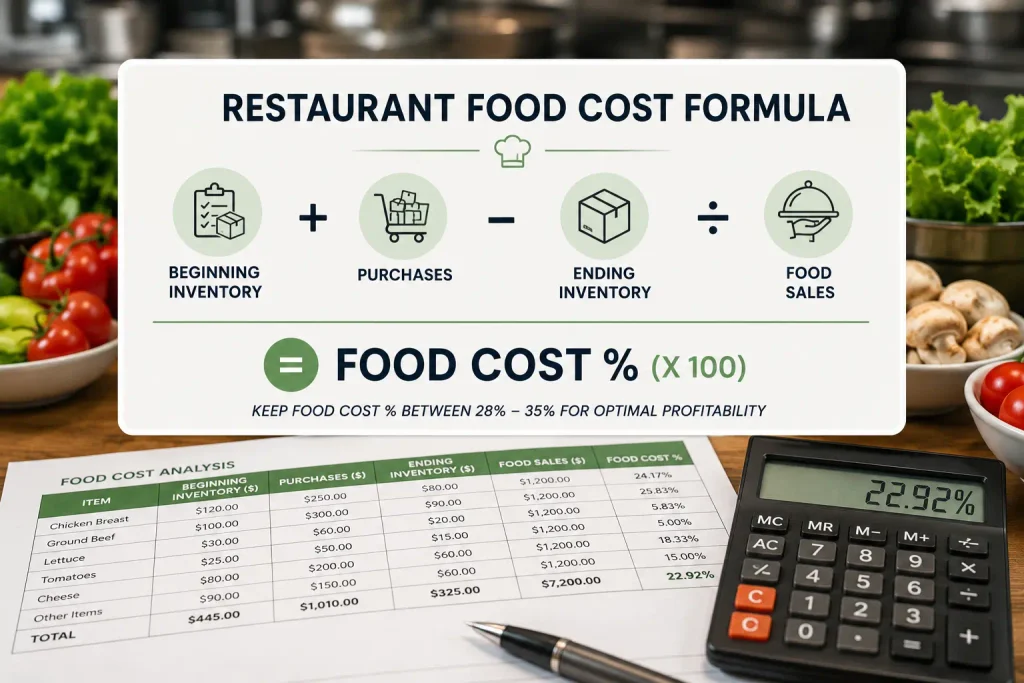
This is the core formula every operator should have memorized:
Beginning Inventory + Purchases − Ending Inventory = Food Cost
Then:
Food Cost ÷ Food Sales = Food Cost Percentage
- Beginning inventory: the dollar value of food inventory on hand at the start of the period
- Purchases: everything you bought during that period
- Ending inventory: the dollar value of what’s left at the end of the period
- Food sales: total revenue generated from food during that same period
Here’s a quick example. Say you started the week with $8,000 in inventory, purchased $4,000 more, and ended the week with $6,000 left. Your food cost for the week is $6,000. If food sales for that week were $18,000, your food cost percentage is 33%. This is the foundational calculation behind how do you calculate restaurant food cost, and it’s typically run weekly or monthly to stay accurate.
How to Calculate Food Cost Percentage
Food cost percentage is what most operators actually care about, since it’s the number that tells you whether your pricing and purchasing are working together.
- Formula: (Food Cost ÷ Total Food Sales) x 100
- Worked example: if food cost is $5,600 and food sales are $16,000, that’s 35%
- Why the percentage matters more than the dollar figure: it lets you compare performance across weeks, months, or even locations
- Segment benchmarks: fine dining tends to run higher due to premium ingredients, while quick-service concepts often target lower percentages
If you’re unsure whether your number is where it should be, our guide on what your food cost should be breaks down realistic benchmarks by restaurant type.
How to Calculate Food Cost for a Restaurant (Menu Item Level)
Calculating food cost at the restaurant-wide level is useful, but calculating it per dish is where the real pricing decisions happen.
- Plate cost: the total ingredient cost to produce a single serving of a menu item
- Recipe costing steps: list every ingredient in the recipe, assign a cost per unit, and total it up
- Portion size and yield: account for trim loss, shrinkage, and usable yield when costing raw ingredients
- Setting menu prices: divide plate cost by your target food cost percentage to arrive at a price that protects margin
Once you have your actual food cost percentage, the real value comes from comparing it against your ideal food cost. That difference, your variance, often reveals exactly where waste or inefficiency is hiding. Read our full breakdown of ideal food cost vs actual food cost to see how to calculate and close that gap.
Common Mistakes When Calculating Food Cost
Even experienced operators fall into these traps, and they can quietly distort your numbers.
- Ignoring waste, spoilage, or theft when tallying food cost
- Failing to update recipe costs when supplier prices change
- Not accounting for comps, staff meals, or promotional giveaways
- Overlooking inventory count accuracy due to rushed or infrequent counts
Small, unaddressed leaks like these are often the biggest reason food cost percentage creeps upward month over month.
Tools and Systems to Simplify Food Cost Tracking
You don’t have to calculate everything by hand, though it helps to understand the math before you automate it.
- Manual spreadsheet tracking: Simple, low-cost, and a good starting point for smaller operations
- Inventory management software: Automates counts and flags variance in real time
- POS integrations: Connect sales data directly to recipe costs for live food cost percentage tracking
- Automated recipe costing: Updates plate costs automatically when ingredient prices shift
The right system takes the guesswork out of tracking and frees up time to focus on the strategic side of the business.
How to Lower Your Restaurant’s Food Cost Percentage
Knowing the formula is only half the battle. The other half is actively managing the number down.
- Negotiate more favorable terms and pricing with your suppliers
- Tighten portion control and reduce prep waste
- Use menu engineering to steer guests toward higher-margin items
- Run regular price audits and re-cost recipes as ingredient prices shift
For a deeper dive into tactics that move the needle, check out our full breakdown on how to reduce food costs in restaurants.
FAQ
How do you calculate restaurant food cost?
Use the formula (Beginning Inventory + Purchases − Ending Inventory) ÷ Food Sales. This gives you your food cost percentage for the period you’re measuring.
What is a good food cost percentage for a restaurant?
Most full-service restaurants target 28-35%, though this varies by cuisine type, service style, and market.
How often should I calculate food cost?
Weekly is ideal for catching issues early. At minimum, calculate it monthly.
What’s the difference between food cost and food cost percentage?
Food cost is the dollar amount spent on ingredients. Food cost percentage expresses that amount as a share of food sales revenue.
Does food cost include labor?
No. Food cost only covers ingredients. Labor is tracked separately, though the two are often combined into “prime cost.”
Conclusion
Calculating restaurant food cost doesn’t have to feel like decoding a secret formula. Once you know the numbers, you know your business. Start with the basic formula, apply it consistently, and revisit your calculations regularly, because supplier prices and menu popularity shift constantly. Small percentage improvements can mean thousands of dollars in saved margin over a year!
Now that you know how to calculate restaurant food cost, the next step is turning that number into action. Start tracking your food cost this week and watch your profitability sharpen.