
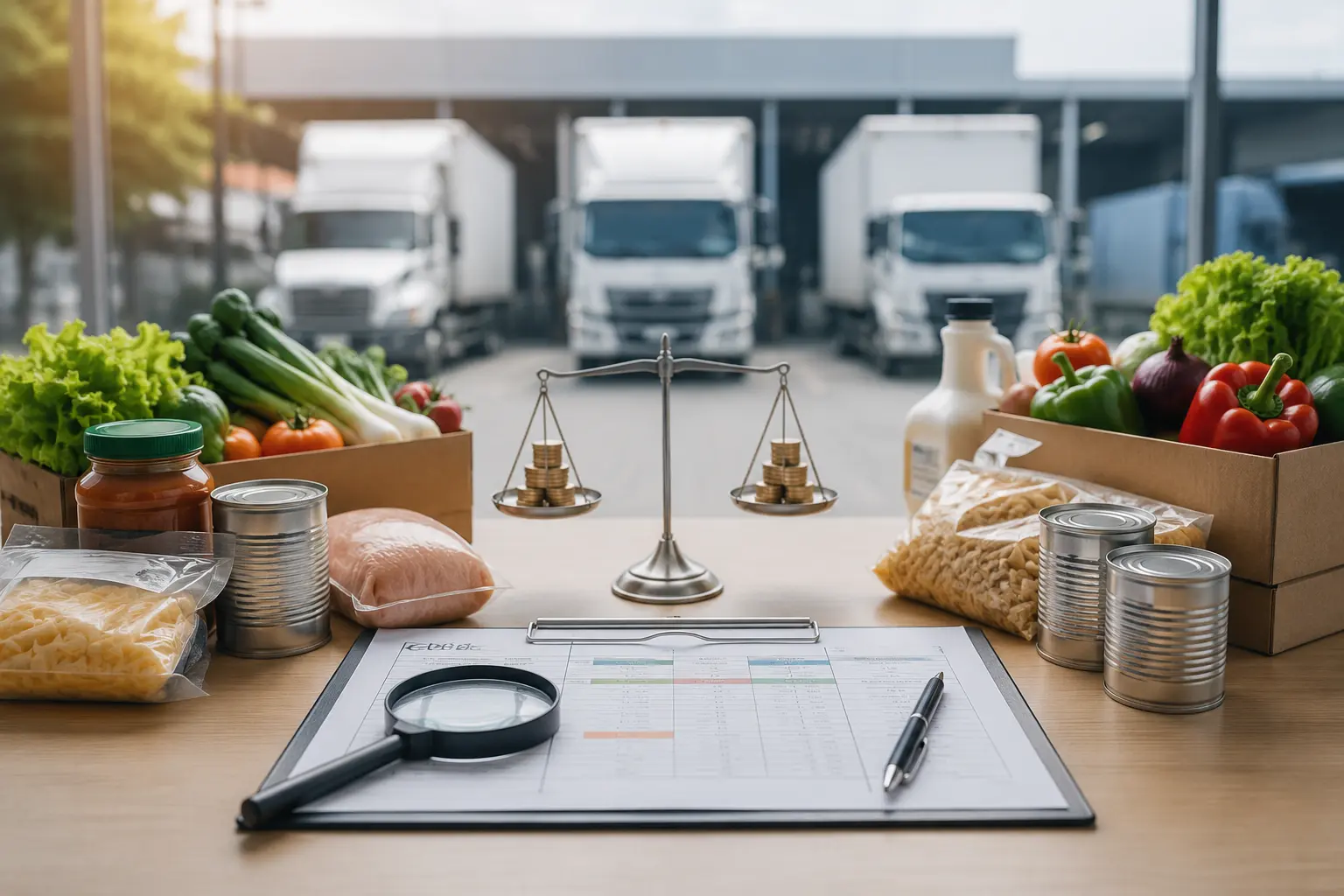
Quick Answer
You can’t compare Sysco vs. US Foods vs. Regional Distributors pricing by looking at case prices alone, here’s what actually determines the real cost:
- Case prices alone are misleading. Pack sizes, fuel surcharges, rebates, and minimum order fees all distort the sticker number.
- Standardize the unit of measure. Convert every quote to cost-per-pound or cost-per-serving before comparing.
- Build a market basket. Benchmark your top 20–30 highest-volume SKUs instead of eyeballing the whole invoice.
- Request itemized invoices, not summarized totals, from every vendor.
- Calculate total delivered cost, not just unit price; freight and fees change the real number.
- Regional distributors often win on perishables (produce, dairy, proteins) thanks to shorter freight runs.
- Sysco and US Foods usually win on breadth and national contract pricing across a full order guide.
- The only reliable check is a side-by-side comparison, which is exactly what Genius’s real-time price comparison software is built to do automatically.
Introduction
Restaurant operators lose thousands of dollars a year without ever seeing a single line item change. How? By comparing invoices instead of comparing value. The debate over Sysco vs. US Foods vs. Regional Distributors pricing comes up in nearly every kitchen office at some point, and for good reason: a case price on one distributor’s sheet rarely means the same thing as a case price on another’s. Pack sizes shift, delivery fees hide, and “discounts” often just offset markups baked in elsewhere.
If you’ve ever tried to line up a Sysco quote next to a US Foods quote and felt like you were comparing two different languages, you’re not imagining it. That’s by design, honestly! Broadline distributors don’t make apples-to-apples comparison easy, and regional distributors add another layer of complexity since their pricing structures often look nothing like the big two.
This guide breaks down exactly how to compare Sysco, US Foods, and regional distributor pricing the right way, so you can stop guessing and start negotiating from a position of actual knowledge.
Quick Comparison: Sysco vs. US Foods vs. Regional Distributors
| Factor | Sysco | US Foods | Regional Distributors |
| SKU breadth | Very wide, national catalog | Very wide, national catalog | Narrower, category-focused |
| Pricing model | Cost-plus / national contract | Cost-plus / Exclusive Brands mix | Often relationship-based, more flexible |
| Best category for savings | Center-of-plate staples, broad order guides | Center-of-plate staples, private label items | Produce, dairy, proteins, local specialty items |
| Freight & fuel surcharges | Standardized, national fee schedule | Standardized, national fee schedule | Often lower — shorter delivery routes |
| Minimum order flexibility | Lower flexibility, set thresholds | Lower flexibility, set thresholds | Generally more flexible |
| Rebates & allowances | Structured national programs | Structured national programs | Case-by-case, less formal |
| Technology/ordering tools | Advanced, app-based ordering | Advanced, app-based ordering | Varies widely, often manual |
| Best fit for | Multi-unit or high-volume operators | Multi-unit or high-volume operators | Independent restaurants prioritizing local sourcing |
This table is a starting point, not a verdict; actual pricing still depends on your market, volume, and order guide, which is why running your own market-basket comparison (covered below) matters more than any general table. Additionally, before comparing Sysco, US Foods, and regional distributors head-to-head, it’s worth confirming you actually have a pricing problem, here are 5 signs it’s time to audit your current distributor.
Why Sysco and US Foods Pricing Is So Hard to Compare Directly
Before you can settle the Sysco vs. US Foods vs. Regional Distributors question for your own menu, you need to understand why the quotes themselves resist comparison in the first place.
- Different pack sizes and unit-of-measure tricks (case vs. each vs. weight-based pricing)
- “Cost-plus” vs. market-basket pricing models explained
- Hidden fees: fuel surcharges, minimum order fees, delivery fees, short-pay penalties
- Rebates, volume discounts, and marketing allowances that distort the “real” price
- Why private-label/house brands make cross-distributor comparison even trickier
Most operators only discover these discrepancies after months of overpaying, which is exactly the gap that a restaurant supplier comparison approach is designed to close — putting every vendor’s price for the same item side by side instead of trusting the invoice as-is.
The Real Cost Drivers Behind Sysco vs. US Foods Quotes

Once you strip away the packaging, a handful of structural differences explain most of the gap between a Sysco quote and a US Foods quote.
- Sysco’s category management and national contract pricing model
- US Foods’ Exclusive Brands strategy and how it affects margins
- Regional buying power vs. national buying power — who actually gets better base costs
- Freight, fuel surcharge structures, and how each company applies them differently
- Contract terms, minimum order requirements, and their hidden cost impact
Neither distributor is “cheaper” across the board; cost drivers shift by category, region, and volume tier, which is why so many operators end up leaving rebates on the table without realizing it.
So, choosing the right distributor is one lever; pairing it with strong cost control processes is what protects margins long-term.
Where Regional Distributors Often Beat the Broadliners
The national players don’t always win. Regional distributors can undercut Sysco and US Foods pricing in specific categories, especially where freight and local sourcing matter most.
- Lower overhead and leaner supply chains in specific categories (produce, dairy, proteins)
- Relationship-based pricing and flexibility on order minimums
- Local/regional sourcing advantages that reduce freight costs
- Faster responsiveness on price adjustments and customer service
- Trade-offs: limited SKU breadth, less tech infrastructure, inconsistent availability
Plenty of independent kitchens end up splitting their order guide between a broadliner and a regional distributor for exactly this reason — nobody wins every category.
Note: For independent operators specifically, distributor choice matters even more; see how we help independent restaurants manage vendor relationships.
How to Build an Apples-to-Apples Price Comparison
This is where the actual Sysco vs. US Foods vs. Regional Distributors comparison gets done, not in a gut-feeling glance at the invoice total, but in a structured, repeatable process.
- Standardizing units of measure across vendor quotes (cost per pound, per case, per serving)
- Creating a “market basket” of your top 20–30 highest-volume SKUs to benchmark
- Requesting itemized invoices instead of summary pricing
- Accounting for total delivered cost, not just unit price
- Using a comparison spreadsheet, or automated software, to track vendor quotes side by side
Doing this manually every week is realistically impossible for most operators, which is why platforms like Genius exist. Genius compares vendor prices in real time on every order, automatically, instead of once a quarter when someone finally has time.
Note: Once you’ve decided which distributor fits your restaurant best, the next step is getting set up. See our full guide on how to open a wholesale account with Sysco, US Foods, or a regional supplier
Questions to Ask Every Distributor Before Signing a Contract
A clean comparison on paper still won’t protect you if the contract terms undo the savings later. Before you sign with any distributor, get clear answers to these:
- What’s included in the fuel surcharge and how often does it change?
- Are there minimum order requirements or short-order fees?
- How are price increases communicated, and how much notice do you get?
- What rebates or allowances apply, and are they guaranteed or contingent on volume?
- Can you audit invoices against quoted pricing regularly?
Vague answers to any of these are a red flag; reputable distributors, national or regional, should be able to explain their fee structure without hedging. Ready to push for better terms with whichever distributor you choose? Our guide on how to negotiate food distributor prices covers the exact tactics and scripts to use.
Multi-Sourcing Strategy: Using All Three Distributor Types Together
The smartest answer to Sysco vs. US Foods vs. Regional Distributors usually isn’t “pick one” — it’s “use the right one for each category.“
- Why relying on a single distributor increases pricing risk
- How to split categories strategically (proteins vs. dry goods vs. produce)
- Leveraging competitive quotes to negotiate better terms with your primary vendor
- Building backup vendor relationships for supply chain disruptions
- Balancing the convenience of one-stop ordering against the cost savings of multi-sourcing
A well-run multi-vendor strategy is one of the simplest restaurant procurement upgrades an independent operator can make; it just requires visibility into pricing across every vendor at once, which is the part most kitchens are missing.
FAQ
Is Sysco or US Foods cheaper overall?
Neither is consistently cheaper; pricing varies by category, region, contract terms, and volume tier. The only reliable way to know is to compare distributor prices item-by-item for your specific order guide, not by comparing overall invoice totals.
Are regional distributors actually cheaper than Sysco or US Foods?
Often, yes, in specific categories like produce, dairy, and proteins where local sourcing cuts freight costs. But regional distributors typically carry fewer SKUs and may lack the technology infrastructure of the broadliners, so it’s rarely an either/or decision.
How often should I compare distributor pricing?
Ideally, continuously; prices shift weekly or even daily on commodity items. At minimum, run a full market-basket comparison quarterly, and audit invoices against quoted pricing every time you place an order.
What’s the biggest mistake operators make when comparing Sysco vs. US Foods pricing?
Comparing invoice totals or case prices without adjusting for pack size, fuel surcharges, and rebates. Two “identical” case prices can represent very different actual costs once delivered cost is calculated correctly.
Can I use multiple distributors without adding complexity to ordering?
Yes, especially with software that consolidates pricing from all your vendors into one dashboard. See current plans and setup if you’re evaluating tools that handle this automatically.
Conclusion
At the end of the day, there’s no universal winner in the Sysco vs. US Foods vs. Regional Distributors debate; it depends entirely on your menu, your volume, and how disciplined you are about tracking real costs. The operators who save the most money aren’t the ones who picked the “cheapest” distributor. They’re the ones who built a repeatable system to compare distributor prices on delivered cost, not sticker price.
Start with your top 20 SKUs, standardize the units, and request itemized quotes from at least one broadliner and one regional distributor. Do that quarterly, and you’ll never get blindsided by a fuel surcharge again. Ready to put this into practice? Pull your last three invoices from each vendor and start building your market basket comparison today, or let Genius Food Purchasing run that comparison for you automatically, across every vendor you already order from.