
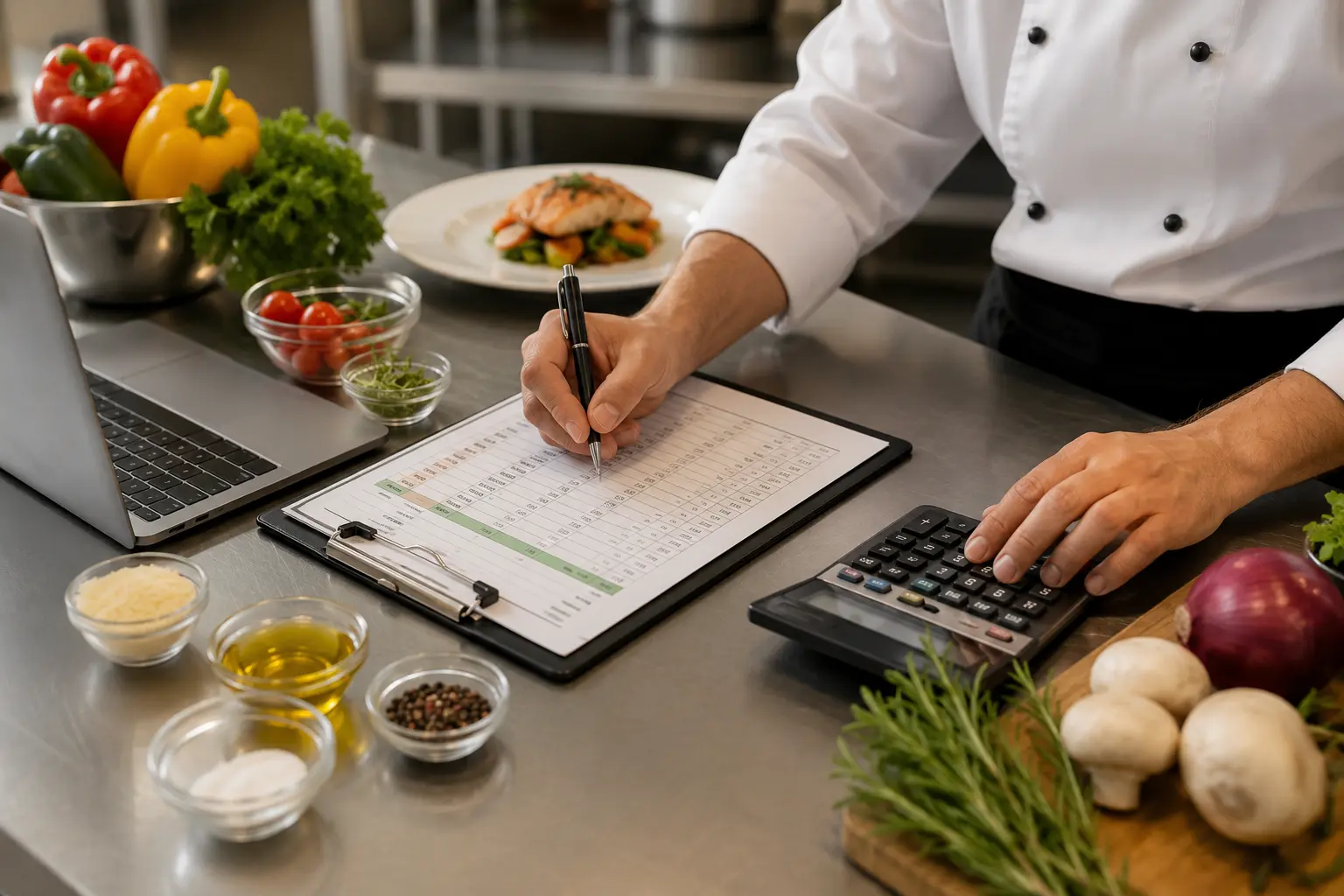
Quick Answer
- Menu costing = calculating what each dish costs to make, then using that to set its price
- Step 1: Gather current vendor pricing for every ingredient
- Step 2: Build a standardized recipe costing card with exact quantities and yield
- Step 3: Calculate food cost % → (ingredient cost ÷ menu price) × 100
- Step 4: Compare against your target food cost — typically 28–35% for full-service restaurants
- Step 5: Price using cost-plus pricing → cost ÷ target food cost % = price
- Recost monthly, or whenever vendor prices, portions, or recipes change
Introduction
Ever priced a dish based on gut feeling instead of actual numbers? You’re not alone, and it’s probably costing you thousands a year. Learning how to do menu costing sounds intimidating, but it’s really just math with a purpose: figuring out exactly what each plate costs you to make so you can price it to actually turn a profit. Industry benchmarks put the average restaurant’s food cost between 28% and 35% of revenue; miss that target and your margins evaporate fast.
I’ve watched operators discover, mid-recosting exercise, that their “signature” dish was quietly losing money on every single order. Ouch.
In this guide, I’ll walk you through the process step by step, so you can stop guessing and start pricing with confidence. Menu costing is one half of a related pair of concepts — see our recipe costing basics guide if you’re starting from a single dish rather than a full menu.
What Is Menu Costing and Why It Matters
Menu costing is the process of calculating exactly how much it costs you, in ingredients, to produce a single serving of a menu item, then using that number to set (or check) your menu price. It’s the single biggest lever you have over your food cost percentage.
Skip it, and here’s what tends to happen: portions creep up, vendor prices rise quietly in the background, and one day you realize your “best seller” barely breaks even. Menu costing isn’t a one-time project either. It’s an ongoing discipline that should live somewhere between the kitchen and the back office.
- What menu costing measures (ingredient cost vs. menu price)
- How it feeds directly into your restaurant’s food cost percentage
- The financial risk of never revisiting your numbers
- Who typically owns this process — owner, executive chef, or GM — and why it works best as a shared responsibility
Step 1: Gather Your Ingredient Costs and Data
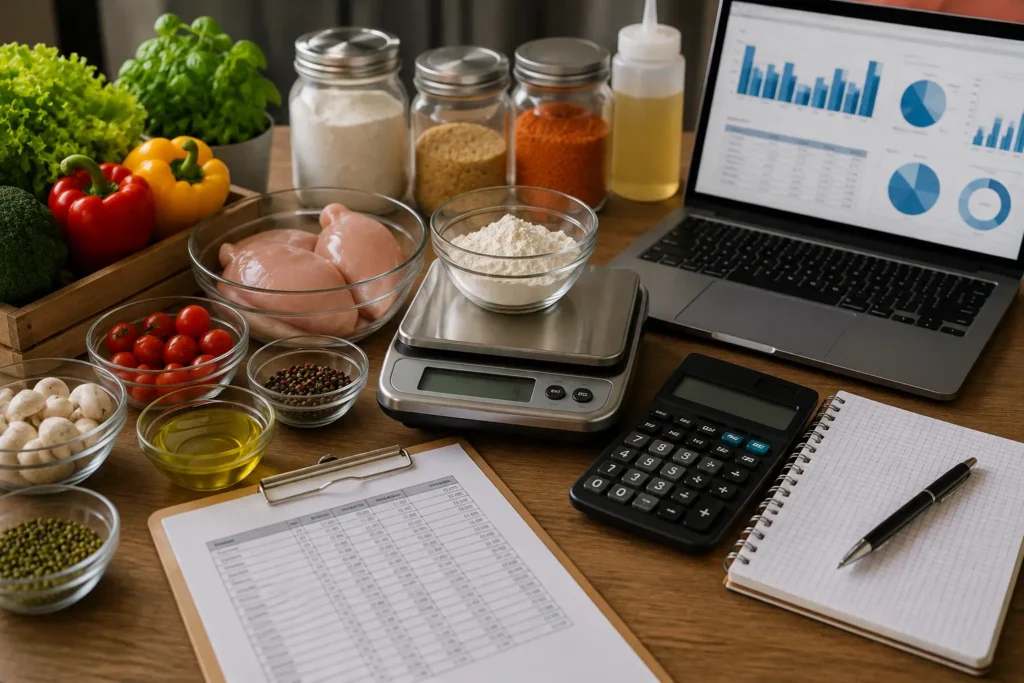
You can’t cost a recipe with stale numbers. Before you touch a spreadsheet, you need accurate, current pricing on every ingredient you buy — and that’s where most DIY attempts at how to do menu costing quietly fall apart, because vendor prices move constantly and nobody updates the sheet.
- Pull current invoice and vendor pricing rather than relying on memory or last quarter’s numbers
- Account for seasonal and market-driven price fluctuations (produce and proteins especially)
- Standardize your units of measure across every ingredient (oz, lb, each) so nothing gets miscalculated
- Compare tracking methods: Manual spreadsheets vs. software like real-time price comparison that pulls live, itemized vendor pricing automatically instead of you chasing invoices by hand
Step 2: Standardize Your Recipes (Recipe Costing Cards)
A recipe costing card is the single source of truth for what goes into a dish — exact quantities, exact units, no eyeballing. Without one, two cooks can make “the same dish” with wildly different food costs, and you’ll never know which version is on your P&L. This step is really the foundation of how to do menu costing correctly, since every calculation downstream depends on it.
- Build a recipe costing card template you can reuse across the whole menu
- List exact ingredient quantities per dish, down to the ounce or gram
- Record yield and portion size so costs scale correctly
- Factor in waste, trim, and shrinkage — raw weight almost always costs more than usable weight
This is exactly the kind of work that’s painful by hand but straightforward with the right recipe costing software, which ties vendor pricing directly to each recipe card so the cost updates automatically as ingredient prices shift, instead of going stale the day you finish building it.
Step 3: Calculate Food Cost Per Dish
This is the math at the center of everything. Once you know exactly what’s in a dish and what it costs, the formula itself is simple.
- The core formula: Food cost % = (Cost of ingredients ÷ Menu price) × 100
- Walk through a step-by-step example (e.g., a $4.50 ingredient cost on an $18 entrée = 25% food cost)
- Avoid common calculation mistakes, like forgetting sauces, oils, or seasonings
- Account for plate garnishes and “freebies” — bread baskets, condiments, and sides that quietly eat into margin
Step 4: Determine Your Ideal Food Cost Percentage
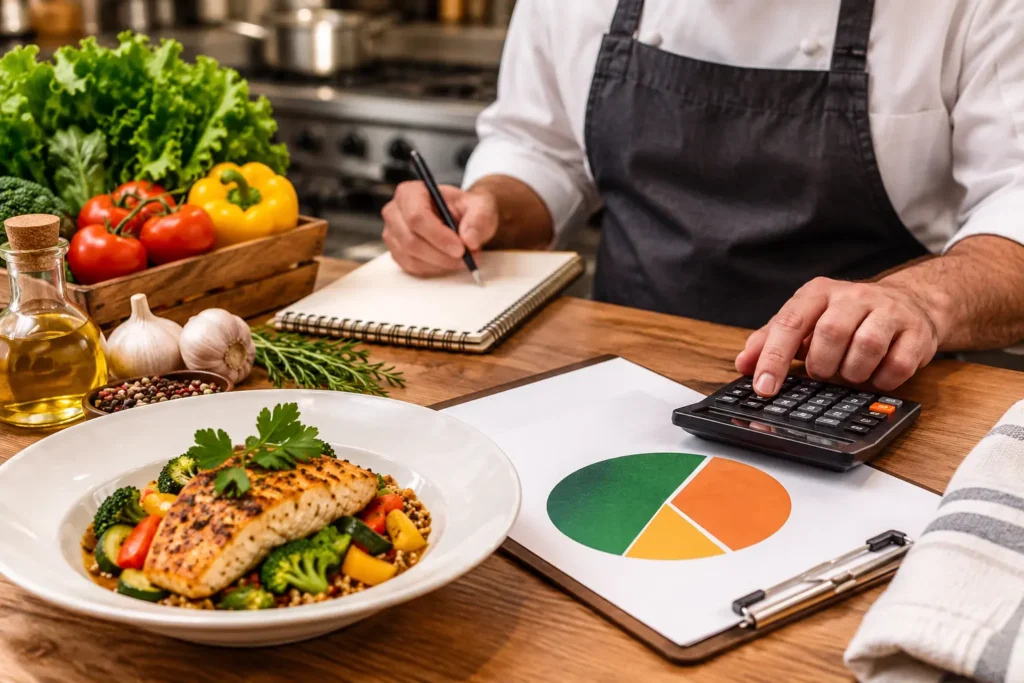
There’s no single “correct” food cost percentage — the right target depends on your concept, your labor structure, and your market. But you do need a target, or every pricing decision becomes a guess.
- Know the industry-standard ranges (most full-service restaurants land between 28-35%)
- Understand how restaurant type shifts the target — fine dining tolerates a higher food cost than a QSR
- Balance food cost % against labor cost and overhead to protect your overall prime cost
- Use your target food cost % as the guardrail for every new pricing decision, not just a number you check once a year
Step 5: Price Your Menu Items Strategically
Your food cost number tells you what a dish costs. It doesn’t automatically tell you what to charge. Pricing strategy is where the art meets the math.
- Apply cost-plus pricing as your baseline (cost ÷ target food cost % = suggested price)
- Weigh competitor-based pricing without racing straight to the bottom
- Use menu psychology and price anchoring — dropping the dollar sign, strategic placement, decoy pricing
- Adjust prices carefully so regulars don’t feel nickel-and-dimed; small, frequent adjustments beat one big jarring jump
Use Menu Engineering to Maximize Profitability
Menu costing tells you the cost of a dish. Menu engineering tells you what to do about it. Once every item has a known food cost and known popularity, you can categorize the whole menu and act accordingly.
- Learn the menu engineering matrix: Stars, Plow Horses, Puzzles, and Dogs
- Identify high-margin items that aren’t selling (Puzzles) vs. high-popularity items with thin margins (Plow Horses)
- Use menu design and placement to nudge guests toward your Stars
- Rotate out or re-engineer chronic underperformers (Dogs) instead of letting them linger
Tools and Software to Simplify Menu Costing
Menu costing by spreadsheet works — until your menu grows, vendor prices shift weekly, and someone forgets to update a formula. At that point, the manual process starts costing you more than it saves. Getting the fundamentals down by hand is essential groundwork, but the right software takes the busywork off your plate once you’ve got there.
- Compare spreadsheet templates against the best recipe costing software
- Know what to look for in menu costing/inventory tools: automatic vendor price feeds, recipe linking, real-time recalculation
- Automate cost updates so a vendor price hike shows up in your food cost instantly, not next month
- Choose a tool sized to your operation — a single-unit independent has different needs than a multi-location group; this is exactly the gap inventory and recipe costing software is built to close, connecting purchasing, inventory counts, and recipe costs in one live dashboard
How Often to Update Your Menu Costing
Menu costing isn’t “set it and forget it.” Vendor prices move, recipes evolve, and a costing sheet from six months ago is basically fiction.
- Recommended review cadence: monthly at minimum, quarterly at the very least
- Recost immediately when triggers hit — vendor price spikes, supply shortages, or a menu change
- Build recosting into a recurring operational habit, not a fire drill
- Track cost trends over time so you can spot creeping ingredient costs before they wreck your margin — pairing this with a restaurant supplier comparison across vendors regularly helps you catch better pricing before a recost even becomes urgent
Questions
FAQs
What is menu costing?
Menu costing is the process of calculating exactly how much it costs, in ingredients, to produce a single serving of a menu item, then using that number to set or check your menu price.
How do you calculate food cost percentage?
Food cost % = (Cost of ingredients ÷ Menu price) × 100. For example, a $4.50 ingredient cost on an $18 entrée is a 25% food cost.
What is a good food cost percentage for a restaurant?
Most full-service restaurants target 28–35%, though the right number depends on your concept, labor structure, and market, fine dining typically tolerates a higher food cost than a QSR.
How often should you update menu costing?
Update your menu costing monthly at minimum, and immediately whenever vendor prices, recipes, or portion sizes change. Many operators also do a full review each quarter
What’s the difference between menu costing and menu engineering?
Menu costing tells you what a dish costs. Menu engineering uses that cost data, alongside a dish’s popularity, to decide what to do about each item, keep it, reprice it, redesign it, or drop it.
What is a recipe costing card?
A recipe costing card is a standardized record of exact ingredient quantities, units, yield, and portion size for a dish, the single source of truth every food cost calculation is built from.
How do you price a menu item once you know its food cost?
Use cost-plus pricing as a baseline: cost ÷ target food cost % = suggested price. From there, weigh competitor pricing and menu psychology before finalizing the number.
Can software automate menu costing?
Yes, recipe and menu costing software can pull live vendor pricing, recalculate recipe costs automatically as prices change, and link those costs to POS and inventory data, cutting out most of the manual upkeep spreadsheets required.
Conclusion
Menu costing isn’t the most glamorous part of running a restaurant, but it’s one of the most powerful. Get it right, and you’ll price with confidence instead of crossing your fingers. Get it wrong, and even a packed dining room won’t save your margins. Now that you know how to do menu costing from start to finish, start with just one recipe card today, run the numbers, and build from there — momentum matters more than perfection.
If you want a clearer picture of where your food cost should actually land for your concept, this breakdown of what food cost should be in a restaurant is a solid next stop. Your bottom line will thank you.