
Quick Answer
- Most restaurants should aim for a food cost percentage between 28% and 35% of food sales.
- Quick-service and pizza concepts often run lower (20–30%), while fine dining can run higher (35–40%) due to premium ingredients.
- Food cost percentage is calculated as (Cost of Goods Sold ÷ Food Sales) × 100.
- The ideal number varies by concept, so it’s best paired with your prime cost (food cost + labor cost), which should stay under 55–60% of sales.
Introduction
Here’s a number that should stop you mid-bite of your own menu: most benchmarks put ideal restaurant food cost at 28–35% of food sales. But if you’ve ever pulled up your P&L and thought, “wait, that can’t be right” — you’re not alone. A lot of independent restaurants are running 5, sometimes 10 points hotter than that, and most owners don’t find out until the bank account tells them.
I get it. Food cost feels like it should be simple. You buy ingredients, you sell dishes, the math works itself out, right? Except it doesn’t — not automatically. Between vendor price swings, inconsistent portioning, and a menu that hasn’t been repriced since prices were lower, food cost has a way of creeping upward while everything on the surface looks totally normal.
The good news: food cost is one of the few numbers in your restaurant you can actually control, week to week, decision by decision. Rent doesn’t move. Your lease doesn’t move. But your food cost? That one’s yours to manage. In this guide, we’ll walk through what “ideal” food cost actually means, how to calculate it correctly, what benchmarks look like across different restaurant concepts, how to do cost control and — most importantly — what to do when your number is too high.
What Is Food Cost Percentage (And Why It’s Not One-Size-Fits-All)
Food cost percentage is the relationship between what you spend on ingredients and what you bring in from selling them. Specifically, it’s your cost of goods sold (COGS) divided by your total food sales, expressed as a percentage. If that number is climbing, your margins are shrinking — even if your sales look great on paper.
Here’s the catch, though: there is no single “correct” food cost percentage for every restaurant. A pizza shop and a steakhouse are playing completely different games, and comparing their numbers head-to-head doesn’t tell you much.
- Food cost percentage measures your overall ingredient spend against sales, restaurant-wide
- It’s different from menu item cost, which looks at the cost of a single dish
- It’s also different from plate cost, which factors in the actual cost to plate and serve that dish, garnish included
- The widely cited industry target is 28–35%, but that range shifts based on your concept, your pricing power, and your local market
- Food cost doesn’t operate in isolation — it works alongside labor cost to form prime cost, arguably the more important number for overall profitability (more on that below)
Knowing your target is step one. Knowing how to actually calculate where you stand today is step two — and that’s where a lot of operators get tripped up.
How to Calculate Your Restaurant’s Food Cost Percentage
The formula itself isn’t complicated. Where people go wrong is usually in the inputs, not the math.
Start with cost of goods sold (COGS):
Beginning Inventory + Purchases − Ending Inventory = COGS
Then apply that to your sales:
Food Cost % = (COGS ÷ Food Sales) x 100
Let’s put real numbers on it. Say you start the week with $8,000 in inventory, you purchase $6,000 in new product, and you end the week with $7,000 in inventory left. Your COGS is $7,000 ($8,000 + $6,000 − $7,000). If your food sales for that week were $22,000, your food cost percentage is roughly 31.8% — right in the target range.
For a more detailed walkthrough of this formula, including how to handle edge cases like comps and waste, see our full guide on how to calculate restaurant food cost.
A few things worth knowing as you run these numbers yourself:
- Actual food cost reflects what really happened — waste, over-portioning, theft, all of it baked in
- Theoretical (ideal) food cost reflects what your food cost should be if every dish was made exactly to recipe, with zero waste
- The gap between actual and theoretical is where most of your profit is quietly leaking out
- Common mistakes: forgetting to account for comps, staff meals, and spoilage — all of which inflate your real cost even when your “purchases” number looks fine
If your actual and theoretical numbers are far apart, that gap is basically a map pointing straight at your biggest opportunities.
Once you know your target range, the next step is calculating actual cost per dish — see our guide to recipe costing.
Ideal Food Cost Percentage by Restaurant Type
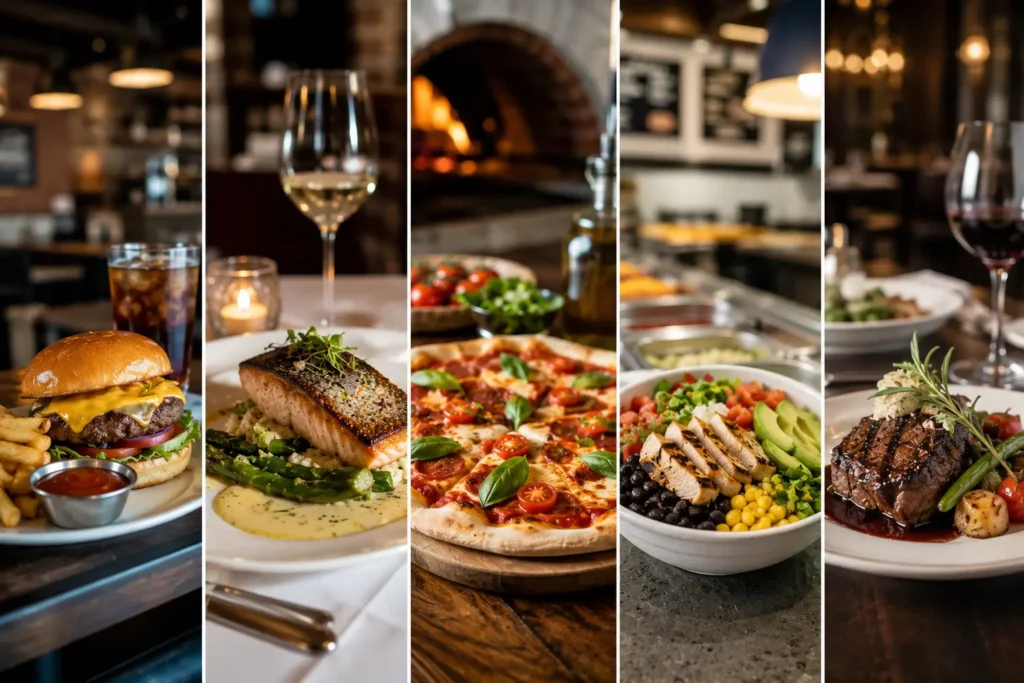
Benchmarks are useful, but only if you’re comparing yourself to the right peer group. Here’s roughly how ideal food cost tends to break down by concept:
- Quick-service / fast casual: generally the lowest range, often 25–30%, thanks to menu simplicity and portion consistency
- Full-service / casual dining: typically lands around 28–35%, with more variability by cuisine
- Fine dining: often runs higher, sometimes 35–40%, because premium ingredients and elaborate plating eat into margin — but menu pricing usually compensates
- Pizza and bar concepts: tend to run lower, often 20–28%, since dough, cheese, and alcohol carry strong margins
- Bakery/cafe: varies widely depending on whether the focus is baked goods (lower cost) or prepared food and beverage (higher cost)
One important caveat here: these ranges are benchmarks, not commandments. A high-end steakhouse in a market where diners expect (and pay for) prime cuts might comfortably run a higher food cost and still be highly profitable, because their pricing and volume support it. Use these ranges as a starting point for comparison, not a strict pass/fail test.
Note: For a full breakdown of how this compares to what you’re actually spending, see our guide on ideal food cost vs actual food cost.
What Causes Food Cost to Run Too High
If your number is above where it should be, it’s rarely one single culprit. It’s usually a handful of small leaks that add up fast.
- Portion inconsistency — no standardized recipes means every cook is plating a slightly different (and often more generous) portion
- Vendor price increases that go unnoticed — prices creep up, menu prices stay flat, and margin quietly erodes
- Poor purchasing practices — sticking with one vendor out of habit instead of comparing pricing regularly
- Waste and spoilage — over-ordering perishables that don’t move fast enough
- Theft or inventory shrinkage — more common than most operators want to admit
- Menu engineering issues — when low-margin items are your bestsellers and high-margin items sit untouched on the menu
The frustrating part is that most of these issues don’t show up as one dramatic event. They show up as a slow drift — a percentage point here, a percentage point there — until suddenly you’re staring at a number that doesn’t make sense.
How to Lower Your Restaurant’s Food Cost Percentage
The fix isn’t usually one big move. It’s a handful of consistent habits, applied weekly instead of occasionally.
- Standardize your recipes — every dish should have an exact recipe card with quantities, so cost per plate stays consistent no matter who’s cooking
- Count inventory weekly, not monthly — the longer the gap between counts, the more waste and shrinkage hide inside it
- Set par levels for every ingredient so you’re ordering what you need, not guessing
- Compare vendor pricing regularly instead of assuming your current supplier is still your best deal — a quick restaurant supplier comparison every quarter can reveal savings you’re currently leaving on the table.
- Track price fluctuations in real time so your menu pricing can keep pace with rising ingredient costs, instead of playing catch-up
- Use food cost or purchasing software to automate the tracking that spreadsheets make tedious and error-prone
- Train your team on waste reduction — proper storage, FIFO rotation, and portioning habits matter more than people expect
None of these are dramatic changes on their own. But stacked together, week after week, they’re usually the difference between a restaurant that’s guessing at its margins and one that’s actively managing them.
Food Cost Percentage vs. Prime Cost: Which Metric Should You Watch Closely?
Here’s something a lot of operators miss: food cost percentage alone doesn’t tell the whole story. The number that ties everything together is prime cost — your food cost plus your labor cost, combined.
Prime Cost = Food Cost + Labor Cost
The generally accepted target for prime cost is 55–60% of sales. Stay consistently under that range, and you’re usually in solid shape. Creep above it, and profitability starts getting squeezed no matter how good your sales numbers look.
Why does this matter so much? Because food cost and labor cost constantly interact. Cut food cost by doing more prep in-house instead of buying pre-cut product, and you might just be shifting that cost over to labor. Watching food cost in isolation can mask what’s actually happening to your bottom line. Prime cost is the number that keeps you honest.
Note: If you’re just getting started, check out our guide on how to open a wholesale account with a food distributor first.
Tools and Systems That Make Food Cost Easier to Control
Manual tracking — the spreadsheet-and-clipboard approach — can work, technically. But it’s slow, it’s easy to mess up, and by the time you notice a problem, you’ve usually already absorbed a few weeks of lost margin.
- Spreadsheets get the job done for very small operations, but they don’t scale, and they rely on someone remembering to update them
- Real-time vendor price tracking flags cost increases the moment they happen, instead of a month later when you’re reconciling invoices
- Recipe costing tools automatically update plate costs as ingredient prices shift, so you’re never pricing a menu item based on outdated numbers
- Reporting dashboards let you compare actual vs. theoretical food cost at a glance, instead of digging through spreadsheets to find the gap
- Purchasing platforms, like Genius Food Purchasing, pull all of this together — vendor pricing, recipe costs, and inventory data — so you’re managing food cost proactively instead of reacting to last month’s numbers
The right system doesn’t replace good habits. It just makes those habits a lot easier to keep up with.
Note: Hitting your target food cost consistently requires ongoing cost control practices, not just a one-time calculation.
Questions
FAQs
What is a good food cost percentage for a restaurant?
A good food cost percentage for most restaurants falls between 28% and 35% of food sales. The right number depends on your concept; quick-service restaurants often target 25–30%, while fine dining may run 35–40% and still be profitable because of higher menu pricing.
How do you calculate restaurant food cost percentage?
Food cost percentage is calculated with two steps. First, find your cost of goods sold (COGS): Beginning Inventory + Purchases − Ending Inventory. Then divide COGS by your food sales and multiply by 100: Food Cost % = (COGS ÷ Food Sales) × 100.
What is the difference between actual and theoretical food cost?
Actual food cost reflects what really happened in your kitchen, including waste, over-portioning, and theft. Theoretical (or ideal) food cost reflects what your cost should be if every dish were made exactly to recipe with zero waste. A large gap between the two usually points to a specific, fixable problem, like inconsistent portioning or vendor price creep.
What is prime cost, and why does it matter more than food cost alone?
Prime cost is your food cost plus your labor cost combined, and it should generally stay under 55–60% of sales. It matters because food cost and labor cost affect each other — for example, doing more prep in-house can lower food cost but raise labor cost. Watching food cost by itself can hide what’s really happening to your margins.
Why is my restaurant’s food cost too high?
High food cost is usually caused by a combination of small issues rather than one big problem: inconsistent portioning, unnoticed vendor price increases, poor purchasing habits, waste or spoilage, inventory shrinkage, and menu engineering issues where low-margin items outsell high-margin ones.
How often should a restaurant count inventory to control food cost?
Restaurants should count inventory weekly rather than monthly. The longer the gap between counts, the more waste, spoilage, and shrinkage can hide inside the numbers before anyone notices.
What is the ideal food cost percentage by restaurant type?
Ideal food cost varies by concept: quick-service/fast casual typically runs 25–30%, full-service/casual dining runs 28–35%, fine dining runs 35–40%, and pizza or bar-focused concepts often run 20–28% due to strong margins on dough, cheese, and alcohol.
How can a restaurant lower its food cost percentage?
The most effective approach is a set of consistent weekly habits: standardizing recipes with exact quantities, counting inventory weekly, setting par levels, comparing vendor pricing regularly, tracking price fluctuations in real time, and training staff on waste reduction like FIFO rotation and proper portioning.
Final Thoughts
So, what should food cost be in a restaurant? For most concepts, somewhere between 28% and 35% is a solid target — but the real answer depends on your concept, your market, and honestly, your prime cost just as much as your food cost alone. There’s no universal magic number, and chasing one blindly can lead you to make decisions that don’t actually fit your business.
What matters more is this: once you know your numbers cold, you stop guessing and start managing your margins with confidence. That shift — from reactive to proactive — is where real profitability comes from.
If you’re ready to stop reconciling invoices by hand and start tracking vendor pricing, recipe costs, and food cost trends in real time, Genius Food Purchasing was built for exactly that. See how it works and take the guesswork out of your food cost.