
Quick Answer
- Food prices change weekly because the forces behind them move constantly: commodity markets, weather, fuel, labor, demand, and trade policy.
- Distributors adjust to match, but your invoice shows the price only at the time of order or delivery.
- That is why restaurant food price fluctuations reach you late, and usually without warning.
Introduction
If your food cost percentage crept up last month and you can’t say why, you’re not alone. Most operators see the damage on the invoice, after the money is already spent.
The averages hide how uneven the swings are. According to USDA Economic Research Service figures reported by RFD News, restaurant prices were up 3.4% year over year through August 2026, while grocery prices rose 2.2%. Inside the basket, the gaps are far wider. In May, retail beef and veal were up 12.9% from a year earlier, while retail eggs were down 35.2%, per the same USDA data. A menu built around both items sees opposite pressures at once.
Below, we explain why food prices change, why your invoice is the last place you learn about it, and what restaurant owners can do about it.
Why do food prices change every week?
Food prices change weekly because a wholesale price is a live reading of supply and demand, not a fixed number. Seven forces move it, often at the same time.
1. Commodity markets. Beef, pork, dairy, wheat, and cooking oil trade on markets that reprice daily. A shift in futures or cash markets can reach wholesale price lists within days.
2. Weather and growing conditions. A freeze in one growing region or a heat wave in another can cut supply of produce almost overnight. Fresh items like lettuce, tomatoes, and berries swing the most because they can’t be stored.
3. Animal disease and herd cycles. Avian influenza drove egg prices up sharply, and the recovery has pushed them sharply down. Tight cattle supplies are doing the opposite for beef. USDA’s 2026 outlook flags beef, fresh vegetables, sugar, and seafood as rising faster than overall food prices, with eggs falling.
4. Fuel and freight. Diesel prices and trucking capacity change what it costs to move a case from the farm or plant to the distributor’s dock, and then to your back door.
5. Labor and processing costs. Packers, processors, and drivers all have wage pressure that gets passed down the chain.
6. Demand spikes. Holidays, grilling season, and big events lift demand for specific items, and wholesale prices rise with them.
7. Trade policy and supply shocks. Tariffs, import limits, port delays, and recalls can remove supply or add cost to an item on short notice.
The result is that no two items on your order guide move together. That is what makes restaurant food price fluctuations so hard to track by hand: dozens or hundreds of items, each on its own schedule.
Why is your invoice the last to know?
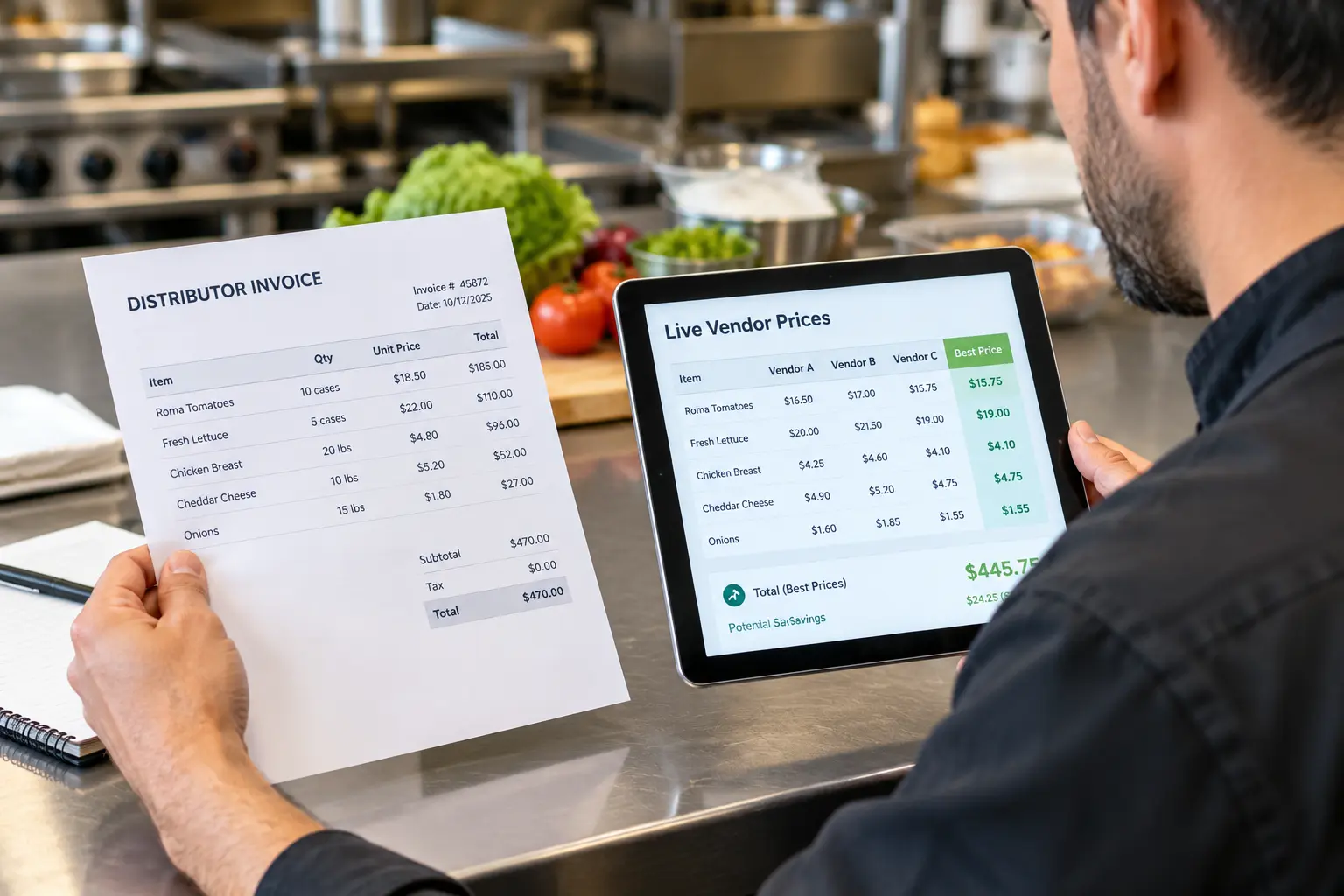
Your invoice is the last to know because it records a price that was set earlier and delivered later. Between a market move and the number printed on your invoice, a price passes through several hands, and each handoff adds delay.
- The market moves. A commodity or freight cost changes.
- The distributor reprices. Distributors update their price lists on their own schedule, and many reprice weekly or even more often.
- Your rep or order guide shows a price. The number you see when you order may already be stale, or may be a contract or “guide” price that doesn’t match what is billed.
- You place the order. Your team is ordering fast, usually from habit and par levels, not from a side-by-side price check.
- The product is delivered and the invoice is issued. The invoice reflects the price at fulfillment. By the time it is reviewed, filed, or entered into your books, the order is already on your shelves.
The invoice is a receipt, not an alert. It confirms what you paid. It cannot tell you that another vendor was cheaper on that same item that morning, or that an item jumped 8% since your last order.
Three things make the lag worse:
- Invoices get reviewed late. Many kitchens check invoices at the end of the week or month, if at all, so a price increase can repeat across several orders before anyone sees it.
- Small increases hide. A few cents per pound on a high-volume item doesn’t look alarming on one invoice. Across a month, it adds up. We call this price creep.
- Recipe costs go stale. If your recipe costs were calculated last quarter, your menu is being priced off old numbers. We cover that problem in detail in Recipe Costs When Vendor Prices Change.
How much do restaurant food price fluctuations actually cost?
For most kitchens, the cost is a slow margin leak, not a single bad invoice. Here is an illustrative example (the numbers are hypothetical, to show the mechanism).
A restaurant orders 10 cases of boneless chicken breast a week from its main distributor. Over three weeks, the main distributor’s price drifts up while a second supplier holds steady:
| Week 1 | Week 3 | |
| Main distributor (per case) | $62.00 | $66.50 |
| Second supplier (per case) | $63.00 | $63.00 |
| Weekly overpay at 10 cases | $0 | $35.00 |
The week 1 order was fine, since the main distributor was cheaper. By week 3, it is $3.50 more per case, and nothing on the invoice says so. At 10 cases a week, that is $35 a week, or about $1,820 a year, on one item. Repeat it across 20 items and the yearly gap passes $36,000.
The cost also shows up in other places:
- Food cost percentage drifts up. Most full-service restaurants aim for roughly 28-35% food cost, and small price increases quietly push you toward the top of that range.
- Menu prices lag. If you price dishes off old costs, your margin on those plates shrinks until you re-cost them.
- Decisions get made on old data. Without live prices, you can’t tell whether an item should be renegotiated, swapped, or dropped from the menu.
How can restaurants manage food price fluctuations?
You can’t stop prices from moving, but you can see the moves sooner and act on them. These five habits work for any kitchen.
- Track your top 20 items. A small set of high-volume items drives most of your food spend. Record their price every time you order so you can spot a jump fast.
- Compare vendors on every order, not once a year. The cheapest vendor on an item changes over time. A yearly bid doesn’t catch that. Learn more about real-time supplier price comparison.
- Review prices before the invoice, not after. Check pricing when you place the order, while you can still switch an item or a vendor.
- Re-cost recipes when prices move. Link ingredient prices to your recipes so plate cost stays current. See how live recipe costing works.
- Set alerts for price creep. Decide what percentage change on an item deserves a call to your rep, and watch for it. Cost control tools can flag it for you.
Doing all five by hand across dozens of items and several vendors is hard to keep up during a busy week. If you’re not sure whether it’s time to automate, here are five signs your restaurant needs real-time supplier price comparison.
Where Genius Food Purchasing fits
Genius is restaurant procurement software that compares vendor prices line by line, in real time, across distributors including Sysco, US Foods, PFG, Gordon Food Service, and 60+ regional suppliers. It sits on top of how you already order, so there are no new vendors and no new workflow for your team. Setup takes 3-5 days.
Because prices are checked on every order, you see the gap before you buy, not weeks later on an invoice. Genius reports that independent operators save an average of 10% or more on food spend in month one.
Frequently asked questions
Why do food prices change so often?
Food prices change often because wholesale prices follow live supply and demand. Commodity markets, weather, animal disease, fuel costs, labor, seasonal demand, and trade policy all move at different speeds, and distributors reprice to match, sometimes weekly.
What causes restaurant food price fluctuations?
Restaurant food price fluctuations come from changes upstream (commodity prices, weather, freight) combined with how distributors price and update their lists. Each item moves on its own schedule, so the total cost of your order changes even when your menu and volumes don’t.
Why doesn’t my invoice show price changes right away?
An invoice shows the price at delivery, after you’ve already ordered and received the product. It records what you paid, so it can’t warn you about a change in advance or show you cheaper options from other vendors.
How often do distributors change prices?
It varies by distributor and by item. Fast-moving categories like produce, proteins, dairy, and oils can change as often as weekly. Check your own invoices over several weeks to see which items move most.
What is a normal food cost percentage for a restaurant?
Most full-service restaurants target a food cost between 28% and 35%, though the right number depends on concept, menu mix, and region. Tracking it against live vendor prices is more accurate than a monthly estimate.
How can I protect my restaurant from rising food costs?
Track your highest-volume items, compare vendor prices on every order, re-cost recipes as prices change, and set alerts for price creep. Restaurant procurement software like Genius automates the comparison so you catch the gap before you buy.