
Quick Answer
- Recipe costing: Calculates what it costs to make one dish — ingredient by ingredient, including portion size and yield loss — resulting in a per-plate cost.
- Menu costing: Takes those recipe costs and multiplies them by sales volume across the entire menu to forecast total food spend over a period.
- Recipe costing answers: “What does this dish cost?” Menu costing answers: “What does running this menu cost?”
- You need both: menu costing is only as accurate as the recipe costs feeding into it.
Introduction
If you’ve ever watched a dish sell like crazy and still lose money, you already know that “the numbers looking fine” isn’t the same as the numbers being fine. I’ve talked to operators who swear by their pricing instincts, and then we pull the actual per-plate cost and the instinct was off by a dollar or more. Understanding recipe costing vs. menu costing is exactly the gap this article is here to close.
Two terms get thrown around constantly in back-of-house conversations: recipe costing and menu costing. People use them interchangeably. They shouldn’t. One tells you what a single dish actually costs to make. The other tells you what your entire menu costs to run, once you scale that dish across real (or projected) sales. Mix them up, and your food cost percentage, your pricing, and honestly your profit margin all take the hit.
This guide breaks recipe costing vs. menu costing down plainly: what each one measures, and how they work together instead of as substitutes for one another.
What Is Recipe Costing?
Recipe costing prices out a single dish, ingredient by ingredient, down to the ounce or gram, accounting for exact portion size and yield loss, to land on a true per-plate cost. If that number comes out to $5.56 for a chicken parmesan, that’s not a guess; that’s the actual cost of putting that dish in front of a guest. This is also why standardized recipes matter, especially across multiple locations: two kitchens making “the same” dish with different portions or swapped ingredients don’t share one recipe cost, they have two, and neither is reliable.
For the full mechanics of building a recipe cost, see recipe costing guide.
What Is Menu Costing?
Menu costing zooms out: it takes accurate recipe costs and multiplies each by the number of times you expect to sell it (or actually sold it), then sums that across every item on the menu to show total cost over a period. If a $5.56 dish sells 20 times, that’s $111.20 in menu cost for that item alone.
For the complete step-by-step process, including formulas and pricing, see our how to do menu costing guide.
Recipe Costing vs. Menu Costing: Key Differences
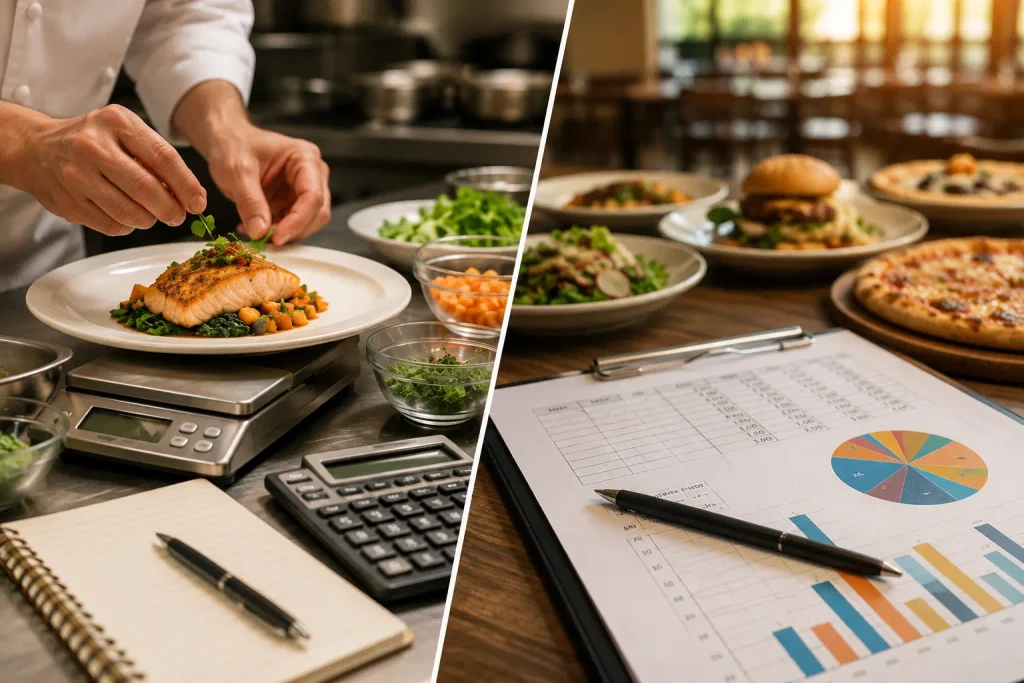
Laid side by side, the difference between recipe costing and menu costing gets a lot clearer:
| Recipe Costing | Menu Costing | |
| Scope | One dish | Entire menu |
| Purpose | Prices an individual item accurately | Forecasts total food spend |
| Frequency | Updated when ingredient prices shift | Recalculated each planning cycle |
| Who uses it | Chefs, kitchen managers | Operations, finance leaders |
| Output | Per-plate cost | Total menu cost over a period |
That quick comparison is really the whole recipe costing vs. menu costing question in one place; one is a zoomed-in number, the other is the rollup of every one of those numbers across the menu.
It’s also worth separating a third, related term: food costing. Where recipe costing zeroes in on a single item, food costing is calculated as total cost of goods sold (COGS) over a specific period, a broader, time-based view that includes everything moving through the kitchen, not just what’s on the printed menu. All three concepts are related, but they’re not interchangeable, and conflating them is where a lot of pricing mistakes start.
Why the Distinction Actually Matters for Profitability
Here’s where the recipe costing vs. menu costing distinction stops being a semantics argument and starts affecting your bottom line.
If you price menu items without accurate recipe costs underneath them, you’re pricing on guesswork, and guesswork quietly erodes margin, dish by dish, week after week. On the flip side, menu costing built on shaky recipe data produces forecasts that look official but aren’t actually reliable.
The real-world consequence shows up in a specific, sneaky way: underpriced dishes can sell great and still drain profit. Sales look strong. The P&L doesn’t match the enthusiasm. That disconnect is almost always a recipe costing problem hiding underneath a menu costing report that looked fine on the surface.
This is also where theoretical vs. actual food cost comes in. Theoretical cost assumes every dish is made exactly to recipe, with zero waste or over-portioning. Actual cost is what really happened. The variance between the two, assuming your recipe costs were accurate to begin with, tells you exactly where money is leaking, whether that’s portion drift, waste, or something getting mis-costed from the start.
How Recipe Costing vs. Menu Costing Is Calculated (Briefly)
Recipe cost: total the exact, yield-adjusted ingredient cost for one dish, then divide by your target food cost percentage to land on a menu price.
Menu cost: multiply each dish’s recipe cost by projected or actual units sold, then sum that across every item on the menu.
Both formulas, with worked examples and the full pricing chain from ingredient to plate to menu price, are covered step by step in our step-by-step menu costing guide
Common Mistakes Operators Make With Recipe and Menu Costing
- Treating recipe costing as “set it and forget it” — ingredient prices move, and costs that were accurate three months ago may not be accurate today
- Ignoring portion drift — inconsistent prep across shifts, stations, or locations quietly changes your real recipe cost even when the recipe card hasn’t
- Building menu costing on outdated recipe data — the forecast only holds up as well as the numbers underneath it
- Skipping the actual-vs-theoretical comparison — this is where most operators miss the exact leaks costing them margin
- Relying entirely on manual spreadsheets — manageable for a single location, error-prone the moment you’re running more than one
That last point tends to hit hardest for independent restaurants juggling costing alongside everything else, and for franchise operations trying to keep pricing consistent across dozens of locations at once. The mistakes look different at each scale, but the root cause is usually the same: costing data that isn’t kept current.
Tools and Software for Recipe and Menu Costing
Manual spreadsheets can work for a single location, with a small menu, and someone disciplined about updating them. That combination doesn’t hold up for long, though, especially once ingredient prices start moving or a second location enters the picture.
What to look for in recipe and menu costing software:
- Ingredient cost databases that update automatically as supplier pricing changes, instead of relying on manual entry
- Yield calculators built in, so waste and shrinkage aren’t left to guesswork
- Integration with POS and inventory systems, so menu costing reflects real sales data, not estimates
- Multi-location support, for operators managing recipe consistency across several kitchens at once
The right platform turns recipe and menu costing from a periodic scramble into an ongoing, accurate part of how the business runs, which matters whether you’re managing one location or fifty.
FAQs
What is the difference between recipe costing and menu costing?
Recipe costing prices a single dish down to the ingredient level. Menu costing aggregates those per-dish costs across projected or actual sales volume to show total cost for the whole menu over a given period.
Is recipe costing the same as food costing?
No. Recipe costing focuses on one item. Food costing is broader — it’s total cost of goods sold (COGS) over a time period, covering everything moving through the kitchen, not just what’s on the printed menu.
Why does the difference between recipe costing and menu costing matter for profit?
Because menu costing built on inaccurate recipe data produces forecasts that look reliable but aren’t. A dish can sell well and still lose money if its underlying recipe cost was wrong — sales volume can’t fix a bad per-plate number.
How do you calculate recipe cost?
List every ingredient and exact quantity, assign per-unit cost based on current supplier pricing, factor in yield loss (trim/shrinkage/waste), total it for a per-plate cost, then divide by your target food cost percentage to set a menu price.
How do you calculate menu cost?
Pull the recipe cost for every menu item, multiply each by projected or actual units sold over the period, sum those totals for total menu cost, then compare against revenue and adjust underperforming items.
Who uses recipe costing vs. menu costing?
Recipe costing is typically used by chefs and kitchen managers. Menu costing is used more by operations and finance leaders, especially caterers, prepared meal companies, and multi-unit or franchise operators forecasting spend.
What’s the difference between theoretical and actual food cost?
Theoretical cost assumes every dish is made exactly to recipe with no waste. Actual cost reflects what really happened in the kitchen. The gap between them — assuming recipe costs were accurate — reveals portion drift, waste, or costing errors.
What are common mistakes operators make with recipe and menu costing
Treating recipe costs as static instead of updating them as ingredient prices shift, ignoring portion drift across shifts or locations, building menu forecasts on outdated recipe data, skipping the actual-vs-theoretical comparison, and relying on manual spreadsheets once operations scale past one location.
Do I need software for recipe and menu costing, or can I use spreadsheets?
Spreadsheets can work for a single location with a small menu and consistent upkeep. Once ingredient prices fluctuate frequently or a second location is added, purpose-built software with automatic price updates, yield calculators, POS/inventory integration, and multi-location support becomes more reliable.
Conclusion
That’s really the whole story of recipe costing vs. menu costing: recipe costing zeroes in on the plate, menu costing zooms out to the whole operation. Neither one replaces the other; you genuinely need both, and they work best when they’re feeding each other: accurate recipe costs in, reliable menu forecasts out.
Once you separate these two out clearly, pricing decisions stop feeling like guesswork and start feeling like strategy. You know exactly why a dish is priced where it is, and you know exactly how that ripples out across the whole menu.
If it’s been a while since you last audited your recipe costs, that’s the place to start — before you build next quarter’s menu costing forecast on numbers that might already be stale. And if you’re still doing this by hand across a growing menu or multiple locations, it’s worth exploring the best recipe costing software before the manual version starts costing you more than it saves. Either way, the goal is the same: know what things actually cost, so your prices can actually protect your margin.